 compound.finance
Compound.finance collateral determines borrowing capacity as asset prices change
Compound.finance collateral supports borrowing, and falling collateral prices can reduce an account’s loan limit. In Compound III, accepted collateral backs borrowing of the market’s base asset. Separate collateral factors govern additional borrowing and liquidation. A price decline can therefore prevent a new loan or collateral withdrawal before the account becomes eligible for liquidation.
The relevant comparison includes recorded collateral, its protocol price, and outstanding debt with accrued interest. Compound III and Compound v2 apply different collateral rules, so a borrowing limit only makes sense within the version and market that hold the position.
Collateral, Interest, and Reward Balances
Compound III tracks token rewards for base asset suppliers and borrowers, subject to the market’s reward configuration and accrual conditions. Supplying collateral alone doesn’t establish reward eligibility. An outstanding reward balance also doesn’t automatically increase the collateral that supports a loan.
Interest follows a separate distinction: a positive base asset balance earns supply interest, while a base asset debt accrues borrowing interest. Collateral assets don’t earn Compound III supply interest. A displayed reward amount therefore shouldn’t be treated as an automatic offset against growing debt.
Market Eligibility and Recorded Collateral
Collateral must belong to the selected market’s accepted asset set before it can support borrowing there. The asset’s configuration identifies its collateral factors, price feed, and supply cap. A token’s presence in a wallet doesn’t establish eligibility, and identical tickers aren’t enough to identify the correct asset contract. Match the asset and account to the market that holds the loan.
A supply operation credits collateral to the designated account. Token approval only authorizes the transfer; it doesn’t itself create that collateral balance. The account’s recorded collateral balance distinguishes an executed supply from an approval or pending transaction.
Borrowing Capacity From Asset Values
Borrowing capacity combines each accepted collateral balance with its protocol price and borrow collateral factor. In a common valuation unit, multiply each collateral quantity by its price and factor, then add the contributions. Compare that total with the value of outstanding base asset debt, including interest. Different assets can contribute different borrowing capacity despite having equal market values. The asset information functions expose these separate factors, so a single portfolio percentage can conceal the weights behind the displayed limit.
Can a Price Drop Block Borrowing Before Liquidation?
Yes, Compound III can reject additional borrowing while its debt remains below the liquidation threshold.
The Borrowing Boundary
The borrow collateral factor governs the debt that collateral can support when borrowing increases. After a price decline, existing debt can exceed that capacity without a new transaction. Further borrowing then requires enough additional collateral or debt reduction to satisfy the borrowing check. A previously available limit doesn’t remain reserved for the account.
The Liquidation Boundary
Compound III uses liquidation collateral factors that are higher than its borrow collateral factors. The difference creates a price buffer between the two boundaries. It doesn’t provide a fixed time allowance: another price movement or additional interest can consume the remaining margin.
Debt Growth Between Transactions
Borrowing interest can reduce collateral headroom even when the collateral price stays unchanged and the account takes no further loan. Compound III’s borrow rate depends on base asset utilization through its configured interest model. The debt comparison must therefore include accrued interest rather than only the original borrowed amount. An unchanged collateral token balance doesn’t establish an unchanged risk position.
Adding Collateral or Repaying Debt
Additional collateral and repayment affect different sides of the same comparison: one increases weighted backing, while the other reduces debt.
Additional Accepted Collateral
A collateral deposit contributes its value multiplied by the applicable factor. The market’s supply cap can prevent that deposit even when the account needs more backing. The cap applies to aggregate supplied units of that asset, and a transaction that would exceed it reverts. Falling prices don’t themselves create room under a cap measured in token units.
Base Asset Repayment
Supplying the base asset to an indebted Compound III account repays its debt. Supplying a different accepted collateral asset adds backing instead. Repayment therefore avoids the need for additional collateral capacity under that asset’s supply cap, although the transfer still needs sufficient funds and authorization. The relevant amount is the base asset actually credited against the intended account’s debt.
Restoring Capacity After a Capped Deposit
Compound III permits debt repayment even when an additional collateral deposit would exceed the collateral asset’s supply cap. In this hypothetical example, all balances, factors, prices, available funds, and transaction conditions are illustrative. After a price drop, an account’s collateral is worth 1,243 base asset units. Its borrow collateral factor is 73%, its liquidation collateral factor is 84%, and its debt is 963 base asset units.
The borrowing capacity is 1,243 × 0.73 = 907.39 base asset units. The liquidation threshold is 1,243 × 0.84 = 1,044.12 units. Debt exceeds the borrowing limit by 55.61 units, while remaining below the liquidation threshold. Additional borrowing fails the collateral test, but this assumed position isn’t yet liquidatable.
With sufficient supply capacity, adding accepted collateral could restore the borrowing margin. Here, assume the market’s cap prevents the intended deposit. The account instead has sufficient base assets and allowance to repay 83 units. Assume successful execution before any intervening interest or price change; debt falls to 880 units, leaving 27.39 units of borrowing headroom.
The successful repayment receipt and the updated account debt establish the completed change. An approval alone wouldn’t establish repayment. A failed repayment leaves the debt unreduced, while later interest or price changes invalidate the calculated headroom. The recorded debt and refreshed collateral check determine whether the account still satisfies the borrowing boundary.
What Does Compound III Liquidation Remove?
Compound III liquidation transfers the liquidated account’s collateral to the protocol and clears its borrowing debt through absorption.
The accounting credits collateral value after the applicable liquidation adjustment and offsets the debt. The account typically retains an excess base asset balance, but it doesn’t retain the original collateral tokens. The liquidation collateral factor determines eligibility; the separate liquidation factor affects the collateral valuation during absorption.
Oracle Prices and Parameter Changes
Collateral checks use the prices that the protocol obtains from its configured feeds. A price shown elsewhere may differ from the value used in the account calculation. Both collateral and debt need a consistent valuation basis, including the base asset’s price. An unchanged number of borrowed tokens can represent a different debt value when that price changes.
Governance can also change collateral factors and supply caps. Those parameters belong to a specific market configuration rather than a permanent rule for a token. A reduced borrow collateral factor lowers borrowing capacity without itself changing the liquidation collateral factor. Read the active values when assessing a position; a proposal describing different values doesn’t establish that those values already govern it.
Compound v2 Collateral Boundaries
Compound v2 represents supplied assets through cTokens, whose exchange rates account for supply interest. Its Comptroller determines collateral eligibility through entered markets and their collateral factors. Account liquidity combines weighted collateral values and subtracts borrow values; a shortfall creates liquidation exposure. Compound III’s separate borrowing and liquidation thresholds shouldn’t be applied to that calculation.
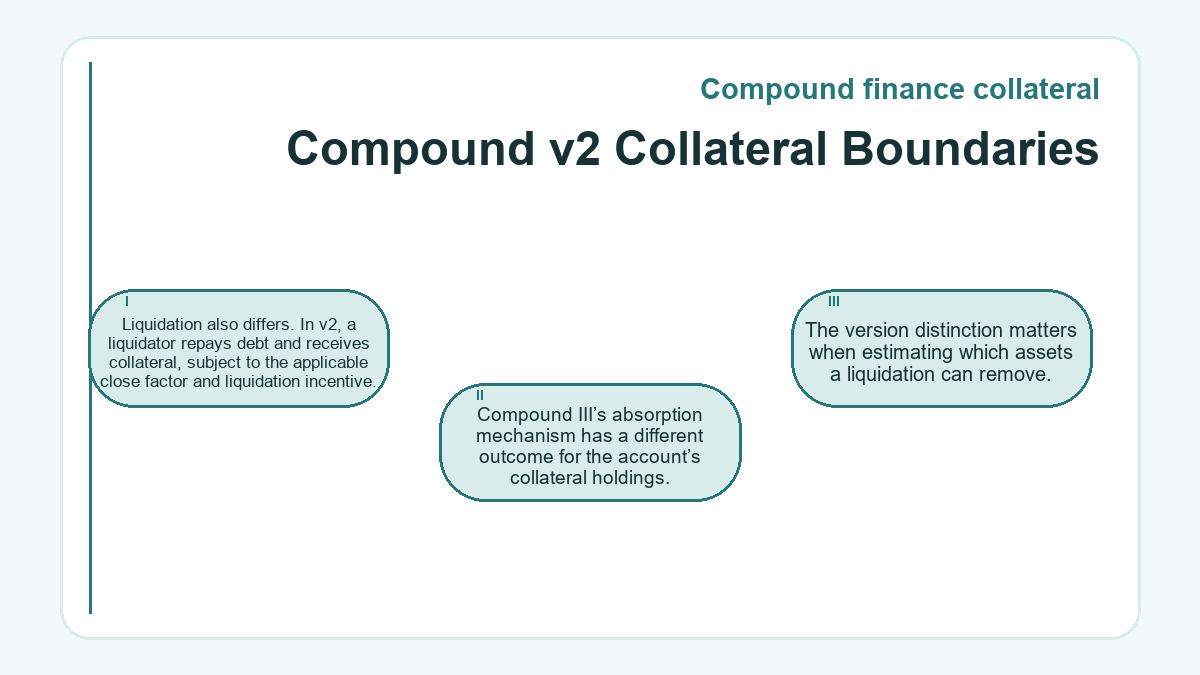
Liquidation also differs. In v2, a liquidator repays debt and receives collateral, subject to the applicable close factor and liquidation incentive. Compound III’s absorption mechanism has a different outcome for the account’s collateral holdings. The version distinction matters when estimating which assets a liquidation can remove.
Withdrawals After Debt Reduction
A collateral withdrawal reduces the backing available to any remaining debt. Compound III checks the resulting position against borrowing collateral requirements, so an account can remain outside liquidation territory and still lack capacity for the requested withdrawal. The amount of collateral on deposit isn’t necessarily the amount available to remove.
Repayment creates room by lowering debt, but a subsequent withdrawal uses some of that room. Assess the remaining collateral after the proposed removal rather than carrying forward the pre-withdrawal limit. A smaller debt alone doesn’t establish that every collateral withdrawal will pass.
Details worth knowing about Compound.finance collateral
Why Can a New Loan Fail Despite Sufficient Collateral?
Compound III applies a minimum borrow balance as well as its collateral requirements. A withdrawal that creates a borrow below the market’s configured minimum can revert even when collateral supports that amount. The market exposes this parameter as baseBorrowMin; it isn’t a universal amount across deployments.
Can an Authorized Manager Withdraw My Collateral Without a Fresh Signature?
An enabled Compound III manager can withdraw or transfer collateral on the account’s behalf without obtaining a fresh owner signature for each action. The account grants that permission through the protocol’s management authorization. The owner can revoke it, and collateral requirements still constrain the permitted operation.
Does Transferring Collateral Within Compound III Send the Tokens to Another Wallet?
An internal collateral transfer changes which account holds the recorded balance while the tokens remain in the protocol contract. A withdrawal instead sends tokens out of the protocol. Moving the recorded collateral away from a borrowing account affects its backing, so an internal transfer remains subject to collateral constraints.
Is a Collateral Factor the Same as a Liquidation Penalty?
A collateral factor determines how much debt an asset’s value can support, while a liquidation penalty affects the value retained through liquidation. Compound III distinguishes the borrow collateral factor, liquidation collateral factor, and liquidation factor. A percentage describing one of these settings cannot substitute for either of the others.