 compound.finance
Compound.finance interest rates change with market utilization
Compound.finance interest rates vary with market utilization, which measures borrowing relative to supply. Each Compound III market has one base asset that users can supply to earn interest or borrow. Separate curves determine supply and borrow interest rates. Other supported assets serve as collateral and don’t earn supply interest. Each curve has a configured kink where its slope changes. A displayed annual rate describes the market at that moment; it doesn’t lock in future income or borrowing costs. Comparing rates therefore requires identifying each quote’s market and balance type and using a consistent annualization basis. Token incentives belong in a separate calculation because they follow different accounting. The useful distinction is between a quoted percentage and the interest that a position accumulates over time.
Contents
Bottom line: Utilization affects borrowing costs and supply income through separate curves, so matching the market and calculation basis matters when comparing rates.
Accruing Interest and Stale Balance Displays
Compound III incorporates base asset interest into account balances through supply and borrow indices. A positive base balance follows the supply index, while debt follows the borrow index. These indices connect stored principal with its interest-adjusted value. Interest accumulation doesn’t require a separate reward-token claim, and an unchanged principal figure doesn’t necessarily mean that interest stopped accruing.
A stale display can obscure that distinction. Refreshing the same account and market is the smallest check before considering another transaction. If a balance still appears unchanged, its displayed precision and the elapsed interval matter. A rounded interface value can hide a small increase. A display based on stored indices can also lag until the protocol updates those indices. Supplying more assets isn’t a diagnostic step for a display problem.
Market Identity and Calculation Units
A usable rate belongs to a specific market deployment and the correct side of its base asset balance. A matching ticker alone doesn’t establish that two displays describe the same market. Compound III exposes supply and borrow rate functions that accept utilization, so their output also depends on the input supplied to the calculation.
The calculation conventions below distinguish raw contract quantities from readable balances and annual percentages. They describe Compound III accounting, rather than a particular market’s changing rate settings.
| Calculation Parameter | Documented Value | Interpretation Constraint |
|---|---|---|
| Interest rate scaling factor | 10 18 | Remove this scale before annualizing a raw per-second rate. |
| Utilization scaling factor | 10 18 | Interpret utilization as a fraction before displaying a percentage. |
| Base balance index scale | 10 15 | Account for this scale when converting principal through an index. |
| Interest accrual time unit | Seconds | Elapsed block timestamps determine the accrual interval. |
| Annualization year | 31,536,000 seconds | This convention represents 365 days, not a promised holding period. |
Token amounts have their own decimal scaling. Applying a token’s decimals to an interest rate produces an incorrect result.
What Happens to Rates Above the Kink?
Utilization above a curve’s kink makes its higher-utilization slope apply to the excess above that threshold. Below the kink, the model combines its base rate with its lower-utilization slope. Above it, the calculation retains the contribution up to the kink and adds the excess-utilization component. The rate remains continuous at the boundary; its sensitivity changes.
Compound III uses separate supply and borrow interest rate models. Their kink positions and slopes needn’t match. A change in utilization can therefore affect supply income and borrowing costs differently. Neither side’s quoted percentage establishes the other side’s rate, and one market’s threshold doesn’t describe every deployment.
Borrowed Balances and Available Liquidity
Compound III calculates utilization from total base asset borrowing divided by total base asset supply. Holding supply constant, additional borrowing raises that ratio. Holding borrowing constant, additional supply lowers it. A market’s available liquidity and its rate curve therefore interact, although the utilization ratio alone doesn’t guarantee that a withdrawal will succeed.
Higher rates can encourage additional supply or repayment, but neither response has a guaranteed timing. Withdrawals still require available assets and compliance with the market’s applicable restrictions. A high supply quote can coexist with limited immediate liquidity. That trade-off matters when comparing interest income with access to the supplied balance.
APR, APY, and Accumulated Interest
APR annualizes a rate without incorporating a compounding assumption, while APY includes the effect of assumed compounding.
Compound III uses 31,536,000 seconds for its annualization year. For a raw per-second rate R, the percentage APR calculation is R ÷ 10 18 × 31,536,000 × 100. The same conversion applies to supply and borrowing, using the appropriate rate function. This calculation translates units; it doesn’t predict the utilization that the market will experience.
APY adds assumptions about reinvestment or compounding frequency. A displayed yield that holds today’s rate constant can’t describe every future balance. Compound III accounts for elapsed seconds through index updates, so second-based accrual shouldn’t be confused with a separate transaction or payout every second. The applicable index, principal, and accrual interval determine the balance calculation.
Measuring earned interest also requires separating it from deposits and withdrawals. For debt, repayments and additional borrowing must remain distinct from interest growth.
Governance and Future Borrowing Costs
Governance can change a market’s interest curve, so unchanged utilization doesn’t necessarily preserve the same future rate. Compound III configures supply and borrow base rates, kink positions, and slopes separately. Implemented parameter changes can alter the relationship between utilization and interest. A proposed setting doesn’t become effective merely because a discussion or vote exists.
Borrowing creates exposure to both utilization movements and implemented curve changes. Accruing interest increases debt even without an additional withdrawal, which can reduce the remaining margin against collateral requirements. The interest quote therefore describes a cost that can change during the position’s lifetime. It doesn’t reserve today’s borrowing conditions until repayment.
Compound III and Compound v2 Supply Models
Compound III calculates supply rates from a dedicated curve, while Compound v2’s jump-rate model derives them from borrower interest. The Compound v2 jump-rate model calculates supply interest as borrow interest multiplied by utilization and the fraction remaining after the reserve factor. That reserve factor allocates part of borrower interest to protocol reserves.
The versions also use different accounting conventions. Compound III expresses rate outputs per second. Compound v2 exposes rates per block, and its supplier interest increases the underlying assets represented by cTokens. Annualizing a per-block rate requires a block-frequency assumption. Comparing unconverted contract outputs mixes different time units and can produce a misleading difference.
The v2 relationship shouldn’t replace Compound III’s dedicated supply calculation. Version identity determines which formula answers the comparison.
Interest Income and Token Incentives
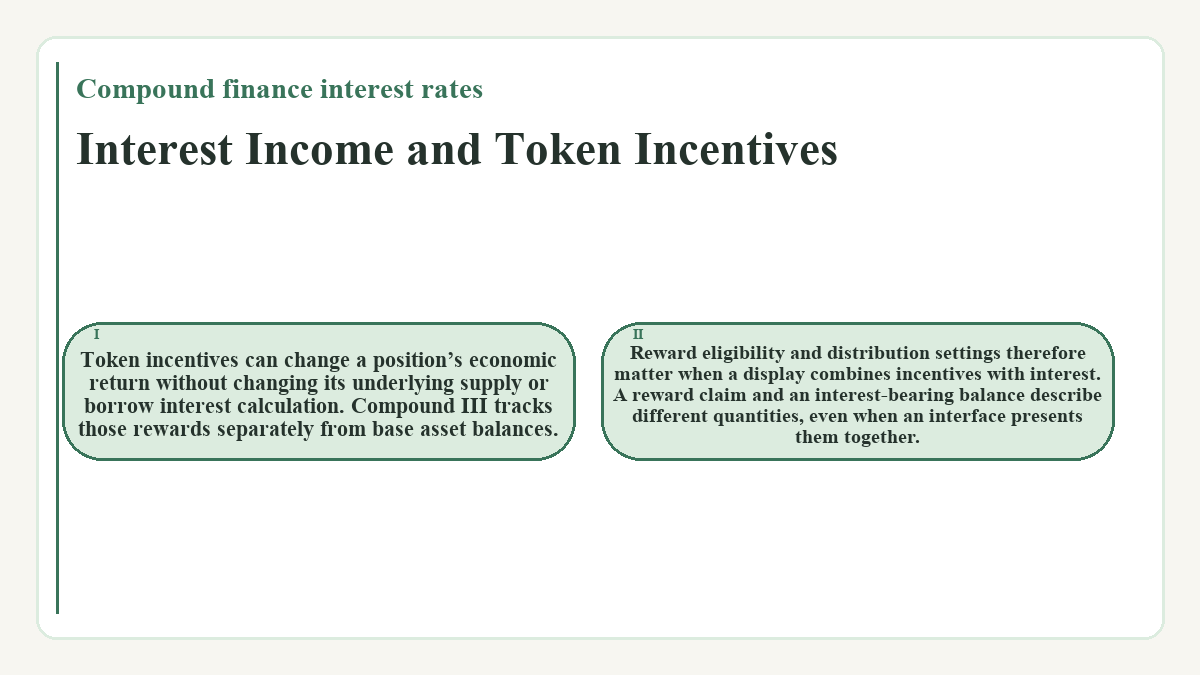
Token incentives can change a position’s economic return without changing its underlying supply or borrow interest calculation. Compound III tracks those rewards separately from base asset balances. Reward eligibility and distribution settings therefore matter when a display combines incentives with interest. A reward claim and an interest-bearing balance describe different quantities, even when an interface presents them together.
A combined return estimate also needs a common valuation basis. Reward-token value can change relative to the base asset, and transaction costs reduce the amount retained. For borrowing, subtracting an estimated incentive value doesn’t erase the debt that interest adds. Compare the position’s return with and without the estimated incentive value, keeping the underlying supply income or borrowing cost separate.
Frequently asked questions about Compound.finance interest rates
Does Approving a Token Start Earning Supply Interest?
Token approval alone doesn’t create an interest-bearing supply balance. Approval permits the market contract to transfer the token within the granted allowance. Compound III supply interest applies to a positive base asset balance recorded in the market. A wallet balance or an approval transaction alone doesn’t establish that position.
Can a Larger Deposit Qualify for a Negotiated Interest Rate?
Compound III’s supply model doesn’t assign a negotiated rate based on an individual account’s deposit size. The market curve determines the rate at a given utilization. A deposit can affect total supply and therefore utilization, but that changes the market calculation rather than creating a personal interest tier.
Will Adding Collateral Reduce the Interest Rate on an Existing Loan?
Adding collateral doesn’t directly reduce Compound III’s market borrowing rate. Collateral affects borrowing capacity, while the base asset’s utilization and borrow curve determine interest. A better collateral position can increase the margin against borrowing restrictions without lowering the percentage charged on outstanding debt.
Is Interest Charged on a Borrowing Transaction That Reverts?
A reverted Compound III borrowing transaction doesn’t create the attempted new debt. Any debt that already existed continues to accrue interest under the market’s model. Transaction execution costs are separate from borrowing interest, so a failed transaction can still consume network fees without increasing the loan by the requested amount.
Could a Positive Supply Yield Still Produce a Loss in Currency Value?
A positive supply yield doesn’t prevent the supplied asset from losing value against a reference currency. Interest measures growth in asset units, while currency returns also reflect the asset’s price. Even an asset intended to track a currency can deviate from that value. Transaction costs can further reduce the return when measured in currency.